
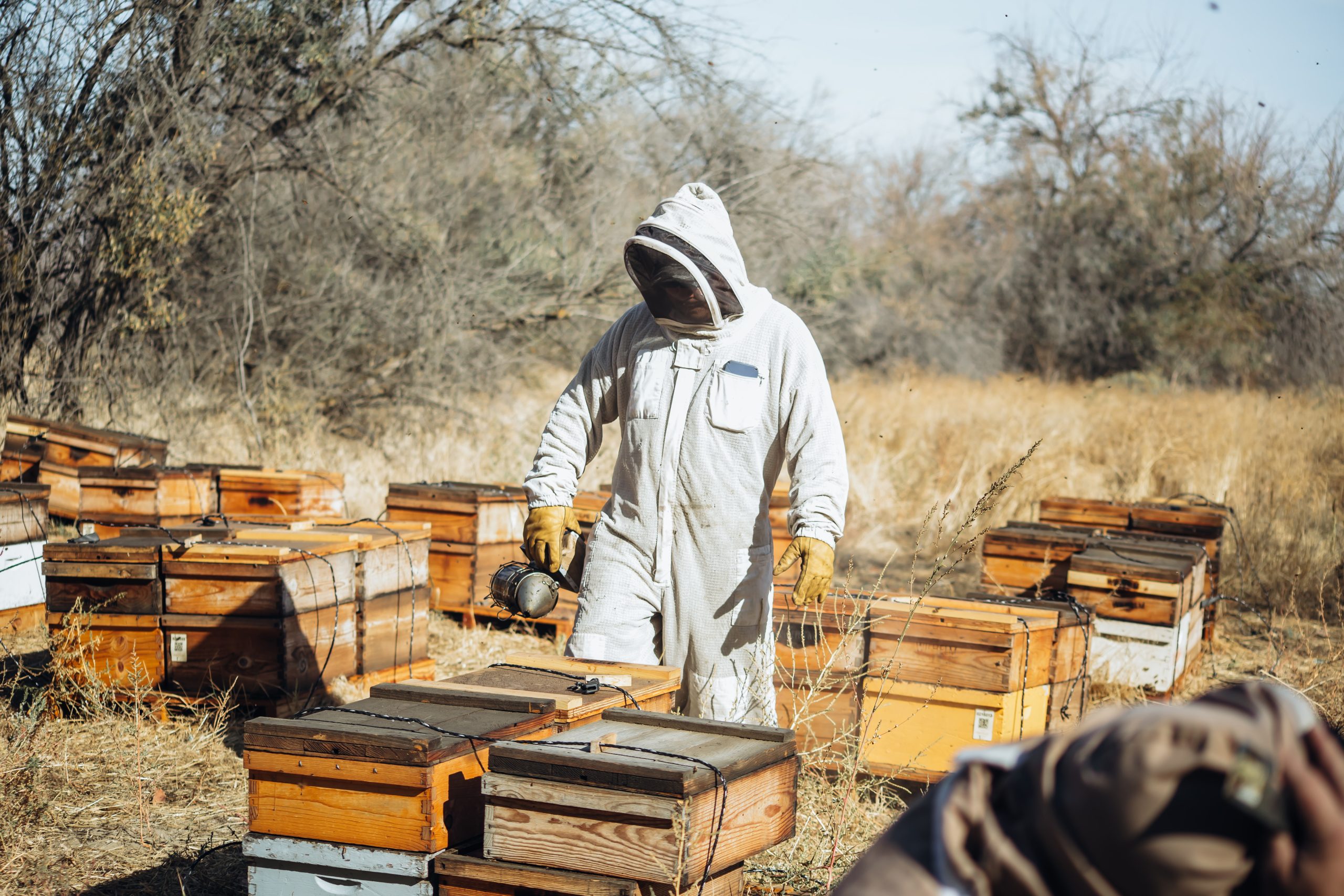
Bud Wilhelm, owner, Royal Honey, Royal City, WA; one of the plaintiffs.
US conventional honey producers can’t compete with illegitimate organic imports
Congress passed the Organic Foods Production Act of 1990 to protect industry stakeholders, farmers, businesses, and consumers from fraud. But a new lawsuit filed by US honey producers claims that regulators have skirted federal law by allowing imports, mostly from Brazil, that do not meet federal organic standards.
While US farmers are certified and inspected every year by certifiers accredited and audited by the USDA’s National Organic Program, the lawsuit, filed in US District Court for the Eastern District of Washington, claims that not only are US organic farmers being competitively injured, but cheap organic imports are making it virtually impossible for conventional honey producers to sell their honey.
The lawsuit contends the agency created foreign-only loopholes that mislead consumers and are pushing US beekeepers out of the market.
“US consumers who rely on the USDA organic seal to guarantee honey is produced by bees feeding in an agrichemical-free environment are being defrauded,” stated Bruce Kaser, a certified organic farmer and activist who, as an attorney, represents the coalition of US honey producers bringing the legal action against the USDA.
Roughly 80% of all honey sold in the United States is imported, a significant amount labeled as organic. Organically labeled product mostly comes from Brazil, where chemically intensive and genetically engineered agricultural production is dominant, even more so than in the United States.
“This is a double standard,” said Mark A. Kastel, Executive Director of OrganicEye, the country’s preeminent organic industry watchdog.
“US farmers and ranchers, by law, are certified by an independent USDA-accredited certifier and inspected each year to ensure they are meeting federal standards,” Kastel added. “Ignoring the conflict of interest, the USDA, astonishingly, delegates inspections to foreign agribusinesses — allowing them to be the ones who oversee the farmer-suppliers they buy from, creating unfair and uncreditable competition.”
Furthermore, in the case of honey, the USDA has created an additional loophole commonly referred to as an “equivalency arrangement” with some foreign countries.
Much of the honey, along with other imports that dominate many organic food sectors in the US marketplace, comes from countries that have standards that the lawsuit alleges are anything but equivalent — although they prominently carry the USDA organic seal.
“As with many other commodities, most US organic honey is imported under a hidden loophole, crafted by political appointees in the US and Canada, and in conflict with provisions of the statute passed by Congress,” said Kaser.
Producing large volumes of organic honey is impossible for US farmers because the USDA requires a 10-square-mile buffer between the nearest agrichemical use and their hives.
Kaser, an investigative lawyer at OrganicEye, claims that Canadian standards for organic honey principally focus on bee survival when feeding in recently sprayed fields rather than the possible contamination of the food supply.
“In bee feeding areas, Canada eliminated the usual three-year prohibition on synthetic fertilizers and chemical sprays, making it possible to site beehives in environments that mirror intensive US conventional agricultural landscapes. These lax Canadian rules are unavailable to US organic beekeepers,” he added.
The equivalency arrangement with Canada, originally designed to prevent US and Canadian growers from having to pay for certification in each country, created a previously hidden organic certificate exchange scheme that is now exploited by countries in Western Africa, Central America, Turkey, former Soviet bloc states, and China, using “Canadian” certifiers based in countries like India or China who exist for the purpose of putting the USDA organic seal on imported commodities never physically passing through Canada, let alone produced in the country. The exchanges are all made exclusively on paper.
“We found one Chinese ‘Canadian’ certifier who apparently shares office space in Hong Kong with a USDA-accredited certifier for the purpose of exchanging certificates,” said Kastel. “Even if the Canadian standards were equivalent, why would we trust these countries, some with endemic levels of commercial fraud, for the organic food we are buying for our families?”
In the case of organic honey from Brazil, the misconception is that it comes from agrichemical-free environments in the wildlands of the Amazon basin. But, based on the number of hives involved and the need to regularly rotate them to new feeding grounds, the reality is quite different — particularly given Brazil’s dominance in worldwide conventional, GMO grain markets.
The lawsuit alleges the USDA has secretly allowed the Canadian arrangement for years, explaining why large quantities of Brazilian honey are available at retailers like Whole Foods Market and Costco, whereas US-produced organic honey has virtually disappeared from the store shelves.
The US producers are seeking the removal of the USDA organic seal from foreign-produced honey labels.
-30-
Get important action items and the latest organic farming and food news delivered right to your inbox.